Police are getting kit to read drone 'number plates': what it means if you fly one
Share this story
A £2m London trial gives police longer-range Remote ID detectors. Here's what your drone broadcasts, which ones must do it now, and the 2028 deadline.
By Tess5 min read
- DJI
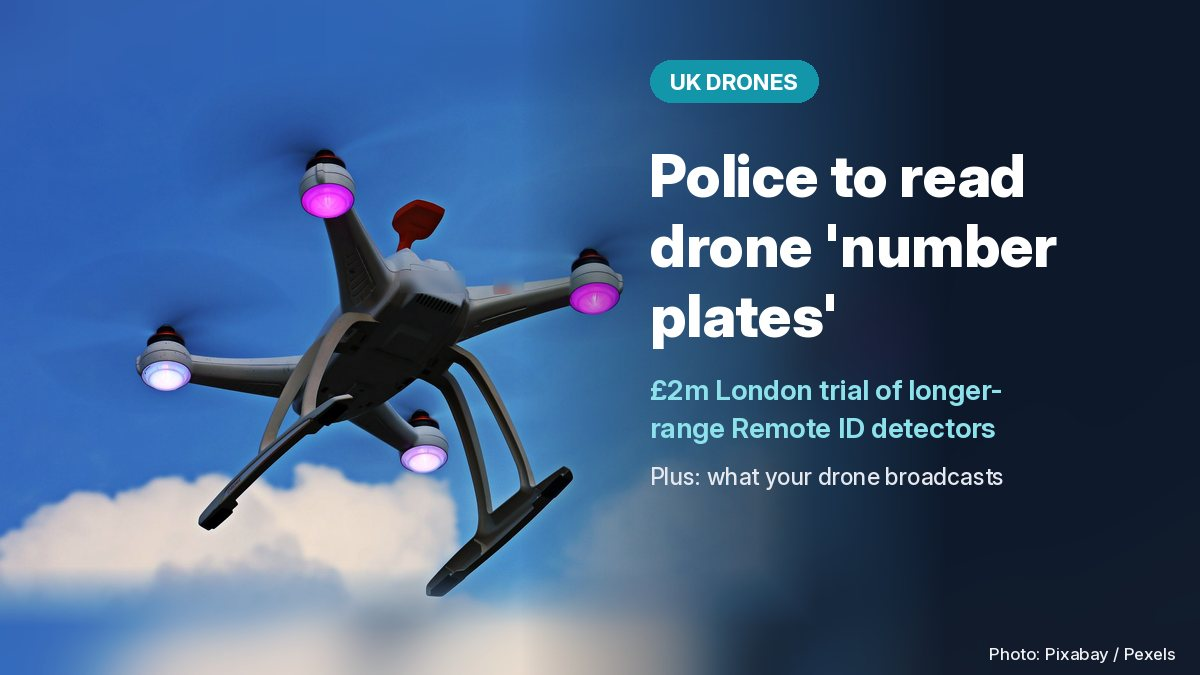
If you've got a drone wrapped and hidden on top of the wardrobe for Christmas, here's something to read before it goes up. The government has put nearly £2 million into a London trial that gives police equipment to pick up drones' digital "number plates" from much further away than they can today.
The Department for Transport announced it on 24 November 2026. It's pitched at the people flying over football grounds, concerts and airports, not at you pottering about over a field in Dorset. But it's built on the same signal your drone may already be sending out, so it's worth knowing what that signal says about you.
What's actually happening
The "number plate" is Remote ID. Drones that have it switched on broadcast their identity and position over Wi-Fi or Bluetooth while they fly. The catch so far is range: the existing broadcasts can generally only be picked up close by. The trial kit is meant to boost both the reach and the accuracy of detection, so police can build a proper picture of drone activity across the capital.
The money is £1.2 million from the DfT, plus £500,000 from the Regulatory Innovation Office for equipment and infrastructure. The National Police Chiefs' Council will decide where the kit goes during the trial.
The government points to disruption at an Arsenal match last month, more than ten drone seizures around Oasis concerts last year, and an aircraft that encountered an illegal drone near Heathrow in October. Rail is on the list too: sensors along the tracks in Birmingham already give police and Network Rail a view of the airspace around key sites.
There's a commercial angle as well. The same tracking is meant to help delivery drones share the sky safely, from NHS pathology runs in London to Amazon's Prime Air service in Darlington. Longer term, the government says it's working on cloud-based drone tracking, which would reach a lot further than a broadcast from a drone's own radio.
Advertisement
What your drone tells the world
Under the Civil Aviation Authority's rules, Remote ID sends this out on a timer during every flight:
- your Operator ID
- the drone's serial number
- its position and height
- the direction it's heading
- where you, the pilot, are standing
- whether it's in an emergency state, such as a low battery
It doesn't broadcast your name or address. Only the CAA and organisations it authorises can link an Operator ID to a person. Still, "where the pilot is standing" is exactly the field a police officer will be most interested in. Treat it as a number plate with a sat nav attached.
Do you need it switched on now?
Depends on the class mark on your drone, which is printed on the drone itself or on its paperwork.
| Your drone | Remote ID required from |
|---|---|
| UK1, UK2 or UK3 class | 1 January 2026, so already |
| UK0 class, 100g or more, with a camera | 1 January 2028 |
| Older drones with no UK class mark, 100g or more, with a camera | 1 January 2028 |
| Home-built, 100g or more, with a camera | 1 January 2028 |
| UK4, which is mostly model aircraft | 1 January 2028 |
From 1 January 2028, Remote ID applies to all drone and model aircraft flights unless the CAA has given you an exemption. The CAA recommends switching it on before then anyway.
European C-marked drones are allowed some slack: until 31 December 2027 you can fly a C1 as if it were a UK1, and so on. The CAA's Remote ID table doesn't list C classes at all, so if you've got a C1 drone, the sensible move is to switch Remote ID on now and stop worrying about it.
Getting it right in ten minutes
- Get a Flyer ID if your drone weighs 100g or more. It's a free online theory test from the CAA, 40 multiple-choice questions, pass mark 30, and you can have the Drone Code open while you take it. It lasts five years. Children can take it too. Under-13s need a parent or guardian with them.
- Get an Operator ID if the drone weighs 250g or more, or 100g or more with a camera. That's almost every camera drone sold this Christmas, the sub-250g ones included. It costs £12.34 a year and you have to be 18 or over, so for a child's drone the parent is the operator.
- Label the drone with your Operator ID, in block capitals taller than 3mm, on the main body. The Operator ID goes on the label, not the Flyer ID.
- Find your Remote ID number in the "My registration" area of the CAA site. It's not the same as your Operator ID. It's case sensitive and ends in a three-character private key.
- Enter it in the drone's app when it asks during setup, or later through the maker's settings. On DJI's class-marked drones it sits in DJI Fly under Safety, then UAS Remote Identification. The drone checks the number and won't accept a wrong one.
- Keep the firmware up to date.
The bottom line
If you fly legally, this trial is good news. It's aimed at the people who make drones look bad, and it should make it easier for the police to tell a properly registered flyer from someone parking a drone over a stadium. The flip side is plain enough: once police can read Remote ID from a distance, "I didn't know" gets harder to argue, and flying without the right IDs can already get you a fine, or worse in serious cases. Ten minutes of admin on Boxing Day morning will save you a lot of bother.
Sources
- GOV.UK: New digital number plates to help police crackdown on criminal drone use (24 November 2026)
- UK Civil Aviation Authority: Remote ID (RID)
- UK Civil Aviation Authority: Remote ID policy programme
- UK Civil Aviation Authority: Getting what you need to fly legally
- UK Civil Aviation Authority: Getting an Operator ID before you fly
- UK Civil Aviation Authority: Flyer IDs and Operator IDs
- UK Civil Aviation Authority: Prepare for the Flyer ID theory test
- Uplink Imaging: Mini 5 Pro Remote ID
- Amazon UK: Prime Air secures SAIL 4 approval from the UK CAA
Cover photo: Pixabay / Pexels.
Share this story
Spot an error? Tell us via the contact page. How we score devices is in the editorial policy.