Gatwick drop-off AutoPay hacked: what was exposed and what to do now
Share this story
Gatwick's AutoPay drop-off payment system has been breached, exposing logins, addresses, number plates and some partial card details. Here's what to do.
By Tess5 min read
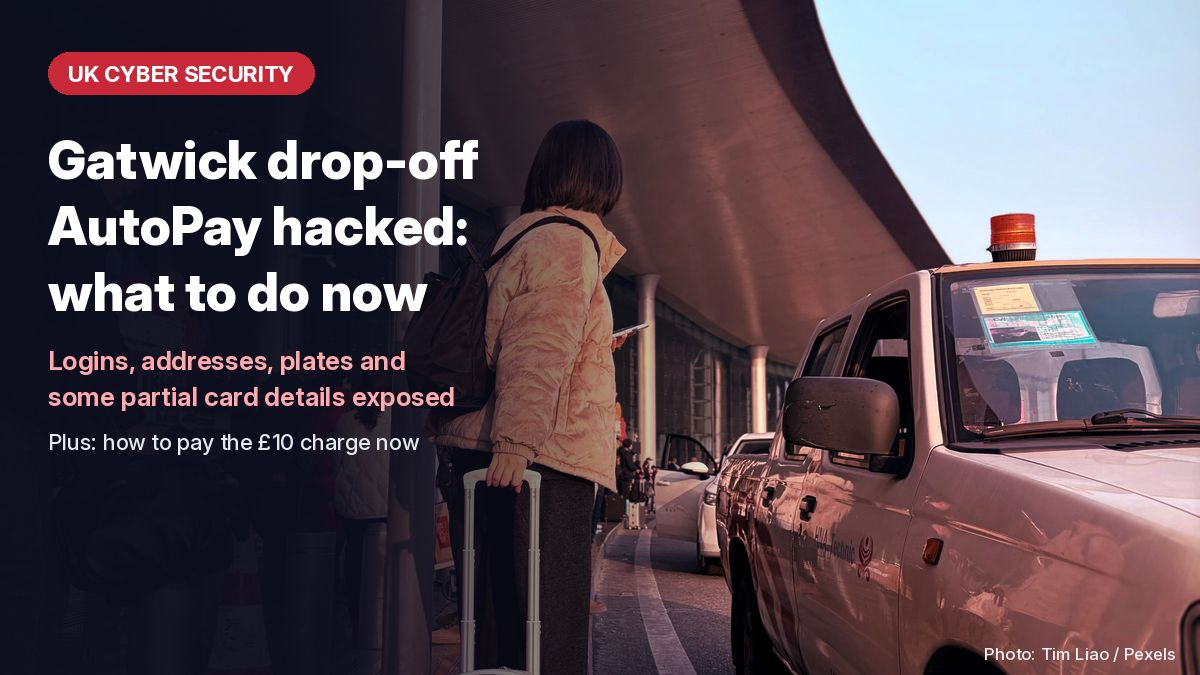
If you've ever dropped someone off at Gatwick and let the number plate cameras quietly bill you for the privilege, this one's for you. London Gatwick has confirmed that AutoPay, the account system that automatically pays the airport's drop-off charge, has been accessed by someone who had no business being there.
The airport says customers who are affected have already been emailed, the Information Commissioner's Office (ICO) has been told, and AutoPay has been switched off while the investigation carries on. Flights, car parks and the drop-off zones themselves are all working as normal. It's just the bit that took your money automatically that's having a lie-down.
What happened
The drop-off zones at the North and South Terminals are run on Gatwick's behalf by a company called Times24 UK Limited. Gatwick says Times24 told it there had been "unauthorised access to AutoPay, a third-party system that automatically processes the payment of drop-off charges".
So this is another supply-chain breach, the now-familiar pattern where a big brand's customers get caught out by a smaller firm sitting behind it. Gatwick hasn't said how the attacker got in, when it happened, or how many AutoPay customers are affected. The ICO says it has received a report and is assessing it.
What was exposed
According to the airport and the notification emails sent to customers, the data that may have been accessed includes:
- AutoPay login details
- Names, home addresses, postcodes and contact details
- Vehicle registrations, plus when vehicles entered and left the drop-off zones
- Payment records: amounts, references, transaction IDs and status, card types and expiry dates
- In what Gatwick calls "very limited" or "isolated" cases, the card brand, the last four digits of the card number and its expiry date
Nobody has said full card numbers or security codes were taken, and the last four digits plus an expiry date isn't enough on its own to go shopping with your card. But it is very handy for something else: sounding convincing on the phone. A scammer who knows your name, address, car, the last four digits of your card and when you were at Gatwick has a far better script than the usual "Hello, this is your bank, probably".
Advertisement
What to do now
- Change your AutoPay password once the service is back, and change it anywhere else you've used the same one. If it's the same as your email password, do that one first. A password manager makes this a lot less tedious.
- Turn on two-step verification for your email account if you haven't already. Your inbox is the master key to everything else.
- Watch your card statements, particularly the card linked to AutoPay. Gatwick has told customers to look out for attempted transactions or requests to authorise payments they don't recognise. It's also worth checking your credit report.
- Assume the next "Gatwick" message is fake until proven otherwise. Fake parking-fine and unpaid-charge texts were a scammer favourite long before this, and now some of them may arrive with your real number plate attached. Don't click links in unexpected messages. Go to the airport's website or the Times24 site directly instead.
- Never read out your full card number, security code or a one-time passcode to anyone who calls you, however much they seem to know. Your bank will never ask for a passcode on a call it started.
- Forward scam texts to 7726 (free on UK networks) and report fraud attempts through Report Fraud.
Don't forget to actually pay
Here's the bit that may catch out more people than the hack itself. AutoPay existed so you didn't have to think about the drop-off charge. With it switched off, you do.
The charge is £10 for 10 minutes, then £1 for each additional minute up to 20 minutes, with a maximum daily charge of £30 and a maximum stay of 30 minutes. It has to be paid by midnight the day after you use the zone. Miss that and you can get a Parking Charge Notice of £100, reduced to £60 if paid within 14 days.
While AutoPay is down you can pay online through the Gatwick website, or by phone on the automated line, 0330 174 4503. Blue Badge holders are still exempt if they register in advance. It's the sort of tax on goodbyes that nobody loves, but a £100 fine on top of a data breach would really be adding insult to injury.
The bigger picture
This lands in the same week that retailer Next disclosed a cyber incident at one of its suppliers, and just after TfL's Oyster photocard breach. The common thread is that you can be careful with your own passwords and still have your details lifted from a system you've never heard of, run by a company you didn't know you were dealing with.
There isn't much you can do about that beyond the basics above. Unique passwords mean one breach stays one breach. Healthy scepticism about unexpected messages means a leaked address and number plate don't turn into an emptied bank account.
We'll update this story if Gatwick or Times24 say more about how the breach happened or when AutoPay will return.
Sources
- The Argus: Gatwick Airport customers' details leaked in system hack
- The Telegraph: Gatwick customers at risk after parking system hack
- LBC: Gatwick Airport drop-off payment system disabled after customer data breach
- MLex: Gatwick reports potential data breach to UK privacy regulator
- London Gatwick: Drop-off charges
- London Gatwick: FAQs
- National Cyber Security Centre: Data breach guidance for individuals
- Report Fraud
Cover image: Tim Liao / Pexels.
Share this story
Spot an error? Tell us via the contact page. How we score devices is in the editorial policy.