TfL Oyster photocard breach: 265,000 customers' details exposed, and what to do now
Share this story
Names, addresses, dates of birth and security answers for about 265,000 Oyster photocard holders were exposed in a TfL breach. Here's who's affected and what to do.
By Tess5 min read
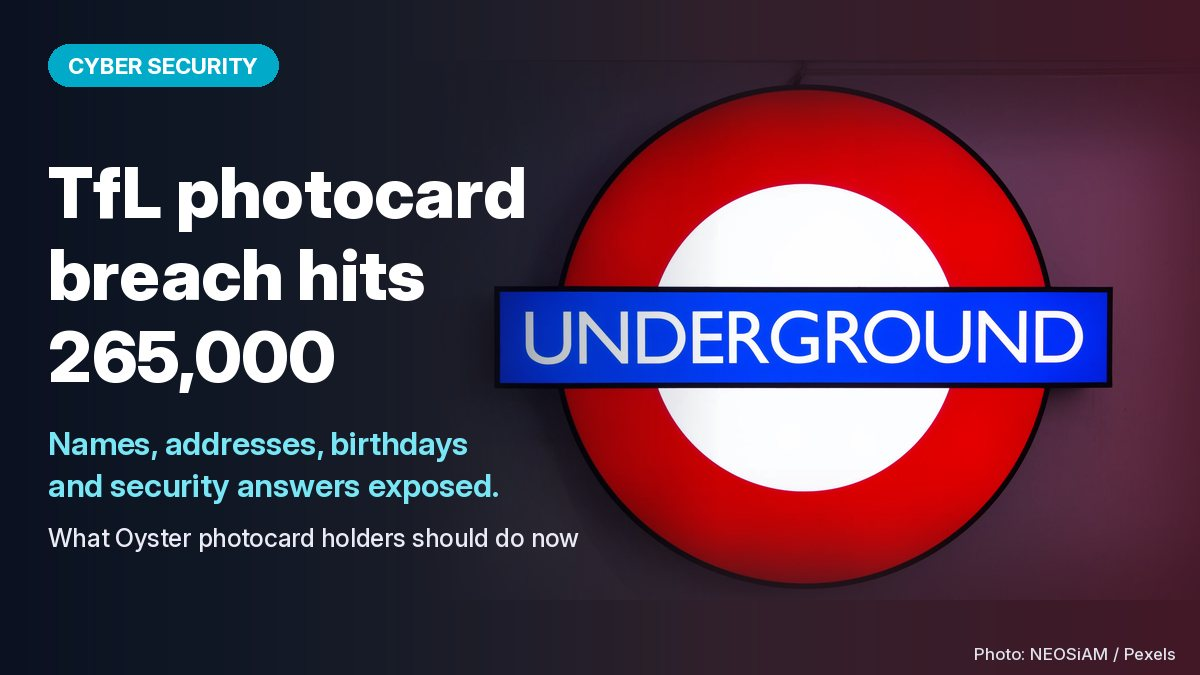
If you get cheaper travel in London on an Oyster photocard, this one is for you. Transport for London has confirmed that the personal details of around 265,000 photocard customers may have been compromised after attackers got into its photocard website this week.
The good news, such as it is: TfL says no passwords, bank or card details, or journey history were taken. The less good news is what was exposed, because it is exactly the sort of material scammers love to have when they ring you up pretending to be someone official.
What happened
TfL says it spotted the problem on Monday 16 November 2026, when photocard customers started receiving emails asking them to create an account, even though they already had one. That's the digital equivalent of a stranger knocking to ask if you'd like a key to your own front door. TfL took the photocard website offline the same day to investigate, and it has told the Information Commissioner's Office (ICO).
By Wednesday, TfL said it had contained the incident and had begun contacting affected customers directly. Its director of technology strategy and revenue, Shashi Verma, apologised and said: "While we acted swiftly, we now believe that around 265,000 photocard customers may have had their account details compromised as part of this incident."
TfL hasn't said who was behind it or exactly how they got in, and the investigation is still going on.
Advertisement
What was exposed, and what wasn't
TfL says the following details may have been accessed:
- names
- email and home addresses
- phone numbers
- dates of birth
- security questions and answers
TfL's current assessment is that these were not compromised:
- passwords
- bank or payment card details
- journey information
- the names and dates of birth of children with a Zip Oyster card
Who is affected
The schemes named by TfL are:
- Zip Oyster photocards (5–10, 11–15 and 16+)
- 18+ Student Oyster photocards
- 18–25 Care Leaver Oyster photocards
- 60+ London Oyster photocards
- Apprentice Oyster photocards
- Veterans Oyster photocards
Your card still works. You can keep tapping in and out as normal. What you can't do for now is apply for or renew a photocard online, because the website remains closed while the investigation continues. If you need to renew, or you have a question about your journey history, TfL says to call customer services on 0343 222 1234.
Why the security answers are the real problem
You can change a password in 30 seconds. Your mother's maiden name, your first school and the street you grew up on are rather harder to swap. If you've used the same security question and answer with your bank, mobile network or email provider, someone else may now know it. Combine that with your name, address, phone number and date of birth, and you have a ready-made script for a convincing scam call.
It also means the next "TfL" message in your inbox could know exactly who you are. A phishing email that uses your real name, address and photocard type is far more persuasive than the usual "Dear Valued Customer" effort.
What to do now
- Change your photocard password and security question and answer once the site is back. TfL is advising all photocard customers to do this as a precaution, not just those it has contacted.
- Change that security answer everywhere else you've used it. Banks, mobile networks, email accounts, the lot. The answer doesn't have to be true. It just has to be something only you know, ideally stored in a password manager.
- If you reused your photocard password elsewhere, change it there too. TfL says passwords weren't taken, but reused passwords are a bad habit whatever happened this week.
- Don't click links in unexpected "TfL" messages. Refunds, renewals and "verify your account" requests are classic follow-up scams. Type tfl.gov.uk into your browser yourself, or call the number above.
- Remember that TfL won't ask for your bank details out of the blue. If a caller knows your date of birth and address, that doesn't make them genuine. Hang up and call back on a number you've found yourself.
- Report anyone who claims to have your data to Report Fraud, the UK's national reporting centre for fraud and cybercrime, on 0300 123 2040 or at reportfraud.police.uk. You can forward suspicious texts to 7726 for free, and suspicious emails to report@phishing.gov.uk.
- Turn on two-step verification for your email and banking if you haven't already. It's the single most useful thing you can do after any breach.
Haven't we been here before?
We have, and recently. In September 2024, a cyber attack on TfL forced it to suspend new photocard applications for more than two months, and customer data was accessed then too. The ICO later decided to take no regulatory action, and in June 2026 two people charged over that incident were each sentenced to five years and six months.
Two serious incidents hitting the same system in just over two years is not a great look. TfL says the speed of its response this time significantly reduced the number of people affected, which may well be true. But "less bad than it could have been" isn't quite the reassurance it sounds like when you're one of the quarter of a million having to dream up a new answer to "name of your first pet".
We'll update this story if TfL says more about how the attack happened or when the photocard website will reopen.
Sources
- BBC News: TfL photocard breach exposes 265,000 customers
- The Telegraph: TfL website hackers steal customers' names and dates of birth
- Transport for London: Cyber security incident in September 2024
- National Cyber Security Centre: Data breach guidance for individuals
- Report Fraud
Cover photo: NEOSiAM / Pexels.
Share this story
Spot an error? Tell the desk via the contact page. How we score devices is in the editorial policy.